Picturesque Goa

Picturesque Goa
NOSTALGIA - Articles,Poems & Photos

TONFERNS CREATIONS

TONFERNS CREATIONS
TONFERNS CREATIONS - Tony's Art & Hobbies

Saturday, December 03, 2016

FEAST DAY OF ST. FRANCIS XAVIER

St. Francis Xavier

Today is the feast of St. Francis Xavier, Apostle to the Far East. His mortal remains lie in the
Basilica of Bom Jesus or Basilica of Good Jesus (Portuguese: Basílica do Bom Jesus) in Goa, India, and is a UNESCO World Heritage Site. The church is located in Old Goa, which was the capital of Goa in the early days of Portuguese rule. 
'Bom Jesus' (literally, 'Good (or Holy) Jesus') is the name used for the infant Jesus. The Jesuit church is India’s first minor basilica, and is considered to be one of the best examples of baroque architecture in India. (Wikipedia) Francis Xavier, born Francisco de Jasso y Azpilicueta (7 April 1506 – 3 December 1552) was a pioneering Roman Catholic missionary born in the Kingdom of Navarre (Spain) and co-founder of the Society of Jesus. He was a student of Saint Ignatius of Loyola and one of the first seven Jesuits who dedicated themselves to the service of God at Montmartre in 1534.[1] He led an extensive mission into Asia, mainly in the Portuguese Empire of the time. He was influential in the spreading and upkeep of Catholicism most notably in India, but also ventured into Japan, Borneo, the Moluccas, and other areas which had thus far not been visited by Christian missionaries. In these areas, being a pioneer and struggling to learn the local languages in the face of opposition, he had less success than he had enjoyed in India.

Saint Francis Xavier was one of the founding members of the Society of Jesus, also known as the Jesuits.

 Basilica of Bom Jesus—Old Goa (Goa Velha)
The body of St. Francis Xavier, Patron Saint of Goa, 
is enshrined here.

 Se Cathedral, Old Goa


Se Cathedral—Main Door Façade, Old Goa


Monday, November 21, 2016

Ottawa by Night


Ottawa By Night
View of the Parliament Buildings and surroundings
from Mackenzie King Bridge over the Rideau Canal.
~ TonFerns Photo ~

Wednesday, November 16, 2016

Sail Along Silvery Moon


~ SAIL ALONG SILVERY MOON ~
A TonFerns Photo
Approx 45 deg. looking East
 15 Nov. 2016 Mississauga - 22.13.26 hrs EST

Monday, November 14, 2016

Supermoon Photos by TonFerns


Apparently, it is the most spectacular supermoon since 1948 lit up the sky, appearing bigger and brighter than usual.

According to astronomers, the moon came closer to Earth than it has done for 69 years.  It happens at the point in the orbit of the moon at which it is nearest to the earth, otherwise known as perigee.

It is believed that nothing will match it until the moon makes a similar approach on November 25 2034.

Friday, November 11, 2016

Dedication to Leonard Cohen

Here's a tune that I've always loved to play on the harmonica in my own humble amateur way. It's none other than 'Hallelujah' which I dedicate to the great Canadian Leonard Cohen, singer, songwriter, poet and novelist who sadly passed away today at 82. May his soul rest in eternal peace.
Image result for hohner harmonica

Echo Harp in the Key of C & G.
 It's a double harmonica with 32 double holes,
 stainless steel covers, and brass reed plates
I've had it for over 40 years.

Please click on the link below to listen.


In Flanders Fields


Image result

IN FLANDERS FIELDS POEM
The World’s Most Famous WAR MEMORIAL POEM
By Lieutenant Colonel John McCrae

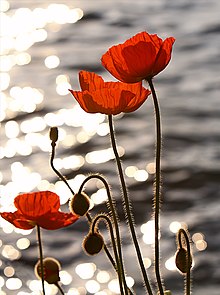
Lieutenant Colonel John McCraeIn Flanders fields the poppies blow
Between the crosses, row on row,
That mark our place: and in the sky
The larks still bravely singing fly
Scarce heard amid the guns below.

We are the dead: Short days ago,
We lived, felt dawn, saw sunset glow,
Loved and were loved: and now we lie
In Flanders fields!

Take up our quarrel with the foe
To you, from failing hands, we throw
The torch: be yours to hold it high
If ye break faith with us who die,
We shall not sleep, though poppies grow
In Flanders fields

Composed at the battlefront on May 3, 1915
during the second battle of Ypres, Belgium

Wednesday, November 02, 2016

All Souls Day

"
The faithful departed lead us to a closer relationship with God,
which is the ultimate goal of the saints.

Tuesday, November 01, 2016

Saturday, October 29, 2016

HAPPY DIWALI


'PONTTI' - Crayon drawing by 'TonFerns'. Known locally in Goa as 'pontti', it is a lamp made out of red clay, average size about 3"x2". Extensively used during Diwali festivities. Arrays of such lamps lit 'en masse' seen on balconies and courtyards of homes, albeit replaced with miniature LED lights in modern times. Traditionally, this type of lamp is lit mainly as a religious offering using coconut oil with a cotton wick in Hindu and Christian homes alike.

Friday, October 28, 2016

Why Me Lord

Why ME Lord

Why me Lord, what have I ever done
To deserve even one
Of the pleasures I've known
Tell me Lord, what did I ever do
That was worth loving you
Or the kindness you've shown.
Lord help me Jesus, I've wasted it so
Help me Jesus I know what I am
Now that I know that I've need you so
Help me Jesus, my soul's in your hand.
Tell me Lord, if you think there's a way
I can try to repay
All I've taken from you
Maybe Lord, I can show someone else
What I've been through myself
On my way back to you.
Lord help me Jesus, I've wasted it so
Help me Jesus I know what I am
Now that I know that I've need you so

Help me Jesus, my soul's in your hand.


Tuesday, October 25, 2016

Past Blasters in Sepia

~ PAST BLASTERS IN SEPIA ~

Destined for life's unknown adventure. These 2 photos were taken miles apart in distance and 3 years in time difference. Embarking on our careers, my picture was taken in 1968 in Abu Dhabi; Edna's was taken in 1971 in Mumbai (then Bombay). Amazing how the B & W photographers of the day seemed to have been influenced by similar studio trends of those days, adopting similar poses and backdrops. Edna & I met in 1974 in Dubai.

Saturday, October 22, 2016

Generations

Boomers I or The Baby Boomers

Born: 1946-1954
Coming of Age: 1963-1972
Age in 2004: 50-58
Current Population: 33 million

Boomers II or Generation Jones

Born: 1955-1965
Coming of Age: 1973-1983
Age in 2004: 39 to 49
Current Population: 49 million

Generation X

Born: 1966-1976
Coming of Age: 1988-1994
Age in 2004: 28 to 38
Current Population: 41 million

Generation Y, Echo Boomers or Millenniums

Born: 1977-1994
Coming of Age: 1998-2006
Age in 2004: 10 to 22
Current Population: 71 million

Generation Z

Born: 1995-2012
Coming of Age: 2013-2020
Age in 2004: 0-9
Current Population: 23 million and growing rapidly

Millenials - They define the group as "as those born in 1982 and approximately the 20 years thereafter.

Friday, October 21, 2016

R.A.F. Radio Station, Sharjah.

R.A.F. Radio Station, Sharjah.

Before the days of FM92 Radio transmission in the UAE, the pioneering expatriate folks who worked and lived there tuned their FM radio to music transmission from the ARAMCO oilfields base in Saudi Arabia. The definitive 3 stations were: Light Music on 100, Classical on 96 and Popular on 88 MegaHertz.

The only other radio program transmission was done by a FM Station in Sharjah in the early 1970's after the base of the British Royal Air Force closed down its radio transmission on Medium Wave.

One of my favourite hits songs of that era was "Those were were the days" sung by Mary Hopkin. As I reminisce today they were indeed fabulous days. Please click on the link below to listen.


Also popular tunes were 'Sound of Silence' by Simon & Art Garfunkel


and 'Lily the Pink' by the Scaffold.


Friday, October 14, 2016

WHY A GOAN IS NOT A GOANESE

WHY A NATIVE OF GOA IS A GOAN
& NOT A GOANESE
and other Demonyms

When a country's name ends with 2 vowels,
an 'n' is added to indicate
a national from that country.


Thus, a person from Goa becomes Goan,

and a .....person from
                  Italia is      -  Italian       (not Italianese)
                  India          -  Indian       (not Indianese)
                  Samoa        -  Samoan    (not Samoanese)
                  Australia    -  Australian (not Australianese)
                  Syria           -  Syrian       (not Syrianese)
                                 -------------------------------------------
....but a person from
                 England is English    -  (not Englandese or Englandian)
                 Ireland is Irish         -  (not Irelandish or Irelandinian)
                 Scotland is Scottish   - (not Scotlandish or Scotlandinian) 
                 Sweden is Swedish  -  (not Swedenese or Swedenian)
                 Switzerland is Swiss-  (not Switzerlandish)
                                 -------------------------------------------
a person from
                 Germany is German - (not Germanese or Germanian)
                 Peru is Peruvian      - (not Perunese or Peruvianese)
                 Canada                     - Canadian (not Canadianese)
                 Tibet                         - Tibetan  (not Tibetese or Tibetanian)                                      -------------------------------------------
and a person from:
                  Nepal     -  Nepalese          (not Nepalian)
                  China     -  Chinese            (not Chinanian)
                  Japan     -  Japanese         (not Japanian)
                  Vietnam -  Vietnamese     (not Vietnamian)
                  Portugal -  Portuguese      (not Portugalese)!
                  Lusitania - Lusitanian        (not Lusitanese)
                                 ------------------------------------------
                  Calabria     -     Calabrian    (not Calabrianese)
                  Panjim       -     Panjimite    (not Panjimese)
                  Bombay     -     Bombay-ite (not Bombayese)
                  Mangalore -     Mangalorean (Mangalorese)
                  Kerala        -     Keralite       (not Keralese or Keralanian)
                  Malabar     -     Malabari      (not Malabarese)
                  Siam          -     Siamese     (not Siamite or Siamian)
                  Uganda      -     Ugandan    (not Ugandanian or Ugandianese)
                  Kenya         -    Kenyan         (not Kenyanian or Kenyanese)
                  Toronto      -    Torontonian (not Torontonese)

Allegedly, the British in the colonial days, who were very fond of the Goans, and considered them as an educated, gentle, law-abiding, faithful and loyal people, in all professions, apparently coined the term Goanese, calling the Goans 'Goanese', whether in fondness, jest or otherwise, whether knowing fully well or not knowing the application of the demonym formula, I am not sure.

Wednesday, October 12, 2016

THE SENIORS OF CUMBIEM MOROD

THE SENIORS OF CUMBIEM MOROD
(The Talented Seniors of Yesteryear)
By Tony Fernandes

Late 1950’s.  My little and lovely ward of Cumbiem Morod. Call it the north-west silent ‘Bairro’  (Portuguese for neighbourhood) of the village of Guirim, bordering the village of Canca to the north-west, Parra to the south,  Sorvem and Figueira wards of Guirim to the east. Sleepy and quaint community with hard-working folks. Sparse Christian and Hindu family homes living peacefully.
Almost a forgotten little ward of Guirim – referred to and known for some reason as a part of ‘small Guirim’. There was no road passing through the village then, but a well-trodden path for many of the people of Candolim, Calangute, Nagoa and Arpora who wished to cut short through our village to Bastora and to the hills and villages beyond.

Though a sleepy ward as it may have seemed, it was a very vibrant one in the 1950’s and 1960’s. The village of Cumbiem Morod consisted of about 15 Christian and 15 Hindu households. The men of Christian homes were employed in Bombay and returned home every year, mostly during the months of April and May.

These men were literate, and very adventurous, having first left their families and homes as early as the beginning of the 1900’s in search of employment in other parts of India besides Bombay (now Mumbai)  like Jodhpur, Ahmedabad and Surat in the north, and even as far down in Kerala in the south. During those days it was difficult to find employment in Goa.

Likewise, the sons of these pioneers later often followed their fathers to work out of Goa. Though these great and adventurous men are no longer with us today, we owe them a lot of thanks for their guidance, for setting good examples in everything they did, for teaching us the good ways and values, and inspiring us in turn to do our best in whatever we attempted to do.

The women folk took care of their children in Goa, and made sure that they got education by sending them to nearby schools, sacrificing the companionship of their husbands. They worked in the fields cultivating two crops a year. Rice was harvested by the end of the monsoons, and various vegetables were grown at the end of the following season in autumn, in allocated patches in front of my ancestral home in Cumbiem Morod (now generally called Kumya) before the onset of winter. This agricultural cultivation provided sustenance during the summer holidays, and even some more to spare in storage for the rainy season with a variety of produce like sweet potatoes, corn, eggplant (aubergine/brinjal), beans, onions, chilies, cabbage and radish. A water-melon patch was planted separately along the raised pathway leading to Monte de Guirim.

The men mentioned below are the ones that I remember, and with whom, at one time or another, I have had contact with, and in retrospect, who I believe have had a good influence on me, with their good example and values. If there are any that I have not mentioned about, it could only be through an oversight.

One of the first brave men and talented seniors from Cumbiem Morod with a firm determination to venture abroad for employment was the resolute Mr. Miguel Mendes, who worked for an oil company in Kuwait in the late 1940’s. He was considered as a pioneer and a role model for the village. A very modest and soft spoken man, he was very unassuming. A father of 7 children - one of his eldest daughters, Terezinha, taught us Cathecism in Sunday School. The village people admired him for his humility and kindness. He was talented in music and played the violin by ear - a talent that he has handed down to his grandson and namesake Michael Mendes along with his brother Savio.

When Mendes Senior returned home on his vacation, the entire village seemed lively. He would have all the village folks at his house for a sung Ladainha (Litany). On Sundays he would hire a bus for all the village kids for a fun trip to Calangute beach followed by a wonderful treat of snacks and cold-drinks thereafter at sunset. He would also reserve a day for a long trek for prayers to his favourite cross on the top of the nearby hills of Canca/ Verla.

On his vacations to Goa during the early 1950’s, the Mendes residence was the first one to be lit up by the wonderful ‘Aladin’ lamp of yesteryear, that lit almost the entire village. It was in their house that I first had first heard the sound of vinyl records on on an HMV (His Master’s voice) gramophone. Vinyl records by Konkani singers like C. Alvares, Minguel Rod, Anthony Mendes, Jacinto Vaz and Kamat de Assolna and Pat Boone’s ‘Remember you’re Mine’ were the one of the first ones that I had heard and seen spinning on this incredible invention of that era.

The first senior to write and stage a ‘Tiatro’ was Custodio Piedade Fernandes. He worked in Bombay and had a grand and happy family of 8 children. His eldest son was a talented artist - my inspiration. Their white-washed house had the largest ‘sala’ (living room) in the village. It was big enough for a ‘ping-pong’ (table-tennis) table. Boys and girls gathered in their home for all sorts of games like carrom, and board- games like draughts, ludo, and snakes and ladders. Their home was like a club house for all the village kids especially during the rainy season. The place next to their house had the least number of coconut trees, so it was ideal to be improvised as a mini football ground for boys of Cumbiem Morod. The windows of their house were always open and the chimney lamp suspended from the ceiling burned bright till late into the night.

Custodio Piedade Fernandes was the oldest ‘Titi’ (uncle), as we addressed him. All the young kids assembled at dusk to listen to episodes of about an hour each every day, which would last for more than a month in total narration time. He must have had a memory of an elephant.  I still admire his great memory and extraordinary prowess in story-telling, which was mind-boggling. I cannot up to this day fathom the power of his mind, or the knack, will or his wit of telling epic stories. Among his other fare included an endless list of episodes at dusk, just before the Angelus, especially during the monsoons, about the adventures of ‘Birbal’ that made us laugh our guts out, while his wife Virginia was getting supper ready for the huge family.

Paulo Monteiro, who we considered as another one of the elders, was a professional photographer, who worked in Bombay during the 1940’s. During his later years Monteiro Senior had come down to Goa for good. He was then working with Kamat Photo Studios in Mapusa (a small town in the north of Goa, in the district of Bardez) as a photographer and laboratory technician, just up the hill, at Altinho. Kamat Studios was situated a few yards down from the residence of the renowned ‘touch and prayer healer’ of yesteryear, the legendary ‘Dixtticar’.

Paulo Monteiro had a collection of plate cameras. The people from our village did not have to travel to Mapusa those days. He would take passport pictures if required just outside his house in the morning, in the existing light and shade of the mango tree next to his house, and he would have them ready by evening. Besides being a professional photographer, Monteiro Sr. was a well-respected senior in our village, and we often looked up to him for guidance and advice. As a young lad I would visit his house at least thrice in a day. In the morning and evening it would be to listen to the radio programmes and evening to play carom or draughts, badminton or cards. He had five sons, two of whom were employed in the Railways in Ahmedabad.

His youngest son, Gabriel, was my best friend and school-mate, who was an aspiring photographer himself. He had a collection of cameras that included a vintage Rolleiflex. He was a natural born photographer and had picked up all the knowledge (and some of the tricks of the trade, so to say) from his father. This talent is evident today, in the fact his profession is still being successfully carried on by Paulo’s grandson, Roque Monteiro.

The fourth in line of seniority was my father, Dionizio (Dennis) Fernandes. His first venture for employment in Bombay was in the 1920’s when he was in his early twenties. He worked hard and put aside savings to build a new home in the same spot where his grandfather’s house stood in our village. He then got married. My older brother and I were born in Bombay. After bringing me to Goa at the age of 6 for schooling, my father came home on leave every year to be with us, and also to repair the house and take care of other matters. Like what most sons would say, my father knew everything about everything, from history to politics, and science to geography. He acquired knowledge from reading newspapers and magazines endlessly, keeping himself abreast of international events and happenings. His World War 2 episodes were worth listening to, and one did not have to refer to an encyclopedia to write an essay in school. He spent his retired life in Goa. He persuaded labourers in the village to put aside savings and taught them how to open bank accounts, accompanying them to banks in Mapusa to have accounts opened for them in their name. People often came to ask him for advice when they were in difficult situations. My father was an active member in the Village Panchayat. He was also instrumental, along with other people of village community, to draft and send the very first application to the government for the urgent need of a road through our village and pursue its outcome with the authorities till he sadly passed away.

Another staunch member of our village community was Mr. Silvestre D’Souza, father of the famous star hockey player of TATA fame in Bombay, Joe D’Souza, well known for his lighting running speed with the ball. He was the eldest son out of 5 children. What I remember Silvestre Titi most for was his Raleigh bicycle which the village boys took for a ride when he was not around! They had an HMV gramophone in the early 1950’s. Although he would not let us kids touch neither the records nor the gramophone, he was very kind and let us wind up the mechanism before playing or whenever it slowed down! He would also make us happy by giving us the chore of sharpening the needles fitted to the sound-box with emery paper. And we were happy with that, and of course with listening to the songs. We owe our musical interest today because of these men – our forefathers! Among the attributes of Silvestre Titi were having a great and loud voice. He must have been a tenor. He was famous for his first burst into song precisely at the moment one raised a glass for a toast at any function. How he remembered all those songs and lyrics beats me up to this very day. His third son, Felix was a great singer and knew by heart all the latest songs of his favourite singers Elvis Presley, Fabian, Cliff Richard and Ricky Nelson. It’s no wonder then that Silvestre’s grandson is also called Fabian and is a famous DJ today. If I remember right, Silvestre himself could have had a voice to beat any modern-day famous tenor. He also had a great and astounding knowledge about sports in general, but more especially about football, hockey, wrestling and boxing. He would tell you the world champion lineage, from Jack Dempsey to Joe Louis, Floyd Patterson to Sonny Liston, and Rocky Marciano to Mohamed Ali to Dara Singh.

Yeshwant Dirgoikar, the construction wizard and craftsman. Although handicapped with a hip injury through most of his adult life, he was more able and talented than most young men his age. He could estimate the number tiles or timber required for a house in a jiffy, based on square footage or even give you an estimate for repairs just by looking at any house. A man of all trades, he could fabricate all sorts of things – from ladders from poles of bamboo to field ploughs and other implements.

Harichand, the labour contractor. Ask him for advice on labour in constructing a house, a shed, or work in the fields during the harvest season. You could rely on him till the paddy in the fields was harvested, threshed, put in sacks and carried to your homes before nightfall.
Abdonio, my favourite ‘Titi’ had an aura about him that made him a very likable character, with his kind and pleasant ways in dealing with us, the youngsters of a bygone era. He was very helpful to all folks of our village, especially the very old.

He sang the litany by heart, word to word. The younger boys of the village relied on him for back-up as he knew all the tunes of the hymns that we sang in the village chapel. During our vacations in Goa during the late 1970’s, my wife and I often visited him in the evening when he related wonderful stories of the olden days that astounded me. I always thought he had a strong resemblance to my favourite American actor – Jack Palance. Before living a retired life in Goa, he had worked in Bombay most of his life.

Benito, the handyman, (Abdonio’s brother) was the tallest man in the village, standing at more than six feet (I think he must have been a least 6’4”). This amazing and admirable man had quite a remarkable stamina for his lean body frame. He could lift a ‘vanso’ or a ‘patti’ (a 15’ ft. ceiling rafter) single-handedly. To me it seemed he never got tired of doing any work. He was an expert for precisely divining water patches in the fields, and helped to dig perfectly square wells and prepare the fields for cultivation. He was a man for all night emergencies, including bringing the doctor to the homes of the villagers during sickness come rain or shine, day or night. Whenever he accompanied us we were never afraid of the dark. A master in the construction and decoration of a ‘matou’ (a very large canopy) for weddings in the village, at most times he did not require a ladder, obviously as he was very tall, perhaps the tallest man in the whole of Guirim, and made quick and short work of most things. We could never have constructed the ‘matou’ (especially for the chapel village feast of Holy Name of Jesus) that was held annually on the 2nd of January without him. I remember that he was the only one who could retrieve the ‘petromax’ from the hook of any ceiling.

There is also something to be said about the women folks of our village, for they were very important too. They all had their own very remarkable qualities of holding the fort and the households while their husbands were away, working abroad. They have to be admired for their hard work, both at home and in the cultivation of the fields. Incidentally, I remember Paulo Titi’s wife, Natalina quite well. She had exceptional wit and humour, besides being a very caring mid-wife. My aunt, Deodita, although handicapped, is reputed to have walked great distances, from Mandrem to Guirim, in the night, returning from a relative’s funeral, and also walked along with other villagers from Guirim to Pomburpa (for the Pomburpa feast) and from Guirim to Betim, on the way to Old Goa, starting at 4 o’clock in the morning. By comparison distances to Calangute, Candolim and Baga were very short for these impressive folks of the olden days. She was so strong that men could not open her closed fist. No wonder then she lived a long life of 93.

Some of the women were even bolder than men. I remember one incident when I was very young. A bull belonging to Sahadev's ancestral clan, near our house, fell into our well. And no one dared to get down into the well to rope him to haul the animal out. It was my daring mother, who tied her sari into a 'kas' and got down into the well, managed to calm the bull down, put 3 or 4 ropes around it, and all other women, men and boys helped to haul it up - happy, alive and well. Hooray!

Assis, the eldest son of Custodio Piedade Fernandes, was my father's godson. Assis and Michael were very fond of taking pictures. They had a box camera in the 1950's. They had the largest collection of photos of almost everyone in the village. The photos were well-mounted using photo corner-mounts in one very thick album. I believe the album still exists, perhaps with Michael (Miki). Miki was a very good natural born artist. His depictions of ‘The Prodigal Son’ & ‘The Good Samaritan’ in black and white pencil shading drawings that hung in the ‘sala’ (hall) were the inspiration for me being an artist. He was a role model - an inspiration to all the younger boys of that era. He was the one who led the entire group of 12 boys in line to school at Monte de Guirim every school day, every morning.
Michael and the older and taller boys ferried us across the stream during the monsoon. This type of leadership, care and concern about the younger generation and community in general, these remarkable instances  have remained etched in my mind until now about our humble existence of another time. Michael taught me how to sing the Hindi song 'Main Rickshawallah' from the movie 'Chhoti Bahen' in 1959 and how to play the box bass made from an old tea chest. When I was in college in Bombay, Michael often visited me to see how I was doing. We have lost a great human being, always smiling and witty, loving and kind, not only to his family members, but also to all those around him.

Conversely, today with the narrow winding road now cutting through the village, it has become a major thoroughfare. Our village has always been unique. Nowadays the number of houses may perhaps have quadrupled in number. Our village has a beautiful chapel which is admired by passers-by and visitors alike. It is, in my opinion, that our chapel which is dedicated to St. Anne is instrumental in maintaining a very close social fabric and friendly relations between neighbours, because if they don’t visit or see each other at their homes, there are chances they will meet in the chapel whenever a meeting is called. Three cheers. Hip, hip, hip, hurray!

Perhaps we will continue this article with additions by other readers, and thus retain and remember our fore-fathers for a long time to come. Amen.

Tuesday, October 11, 2016

The Sorngo

The ‘Sorngo’
By Tony Fernandes

A popular sport during the Portuguese era in the 1950's was known as ’the flying of the sorngo’. It consisted of a framework made of bamboo ribs fastened together with coir rope, lined with tissue paper, and cotton rags tied to a wire at the bottom. It’s shaped resembled an elongated oil drum. It was open at the bottom with a hole at the top. The base of the ‘sorngo’ was held together at the bottom by cross wire tied to its circular framework A lump of cotton rags was tied to the bottom centre.

The art of getting this contraption aloft was based on the rustic knowhow and ingenuity of the ace innovator of our village who was none other than the great Custodio Piedade Fernandes. The ‘sorngo’ was entirely made at home. This innovation was based on the generally principle of fact that hot air inside a balloon causes it to rise aloft.

Multi-coloured craft tissue paper was applied to all sides and the circular top of the bamboo ribbing framework, leaving an open hole at the top for the hot air to escape. After the completion of this ‘flying drum’, a small fire was lit by burning a small cluster of dried leaves from the mango tree. The drum was held over the fire by 2 persons over the flames of this fire that in turn ignited the cotton rags that were soaked in kerosene. And voila in a jiffy we had lift-off to the cheers of the folks gathered around the bonfire in anticipation. To watch it finally soar into the sky since the start of the day brought great joy and satisfaction. Houston would have been proud!
The hole at the top let the smoke escape, while the cotton rag drenched in kerosene acted as a ballast or stabilizer keeping the balloon upright and steady.

As the ‘sorngo’ gradually lifted upwards, the westerly winds pushed the gadget over and towards the fields east of Guirim, towards Bastora. The senior boys ran in the direction of ‘sorngo’ keeping it in sight looking momentarily upwards toward the skies as they ran. The best fun and excitement was the task in retrieving as fell to the ground after the cotton rag had burnt itself out.
As it was considered a fire hazard this sort of sport and entertainment was eventually banned by the Portuguese, in order to prevent fires that could have been caused when these contraptions descended on thatched huts, houses and other property while the embers from the cotton rags still smouldered as they came down.

Those were the days, but now, I think it is absolutely illegal to send this sort of thing into the skies by any means. This write-up is for keeps for posterity. You can make it, but do not fly it. The reason for its ban is that it is a huge fire hazard once it lifts into the sky. Once it soars upwards it was entirely at the mercy of wind with no definite pattern of direction or control. And there is nothing one can do about it.

Sunday, October 09, 2016

Hopeful Clouds


“Hope is like a word made with cloud,
without faith, it quickly blows away.”
― Anthony Liccione

Thursday, October 06, 2016

Wednesday, October 05, 2016

How to Reach a Port


“To reach a port we must set sail –
Sail, not tie at anchor
Sail, not drift.” 
~  Franklin D. Roosevelt  ~

Tuesday, October 04, 2016

Here I am Lord

Here I Am, Lord.

Lord, please heal me.

My all-time favourite Hymn
sung by
golden voiced singer
DANIEL O'DONNELL
https://www.youtube.com/watch?v=VyHTkGrLicg
1.
I, the Lord of sea and sky,
I have heard My people cry.
All who dwell in dark and sin,
My hand will save.
I who made the stars of night,
I will make their darkness bright.
Who will bear My light to them?
Whom shall I send?

Chorus
Here I am Lord, Is it I Lord?
I have heard You calling in the night.
I will go Lord, if You lead me.
I will hold Your people in my heart.

2
I, the Lord of snow and rain,
I have born my peoples pain.
I have wept for love of them, They turn away.
I will break their hearts of stone,
Give them hearts for love alone.
I will speak My word to them,
Whom shall I send?

Chorus

3
I, the Lord of wind and flame,
I will tend the poor and lame.
I will set a feast for them,
My hand will save
Finest bread I will provide,
Till their hearts be satisfied.
I will give My life to them,
Whom shall I send?

Chorus

Monday, October 03, 2016

Memories of the Tour of Rajasthan, India

Memories of a Tour of Rajasthan (2011)
My photo stills into video. Music by my favourite virtuoso Indian pianist Brian Silas with his rendition of 'Ye Jeevan Hai Is Jeevan Ka'.
By train : Goa to Jaipur
Tour of Rajasthan: in a Toyota Qualis.
Return : Jaipur to Goa by train 
Kind courtesy : Leo & Lourdes Kapoor
Jaipur - Bikaner - Jaisalmer - Jodhpur - Udaipur - Chittaurgarh - Ajmer
With sincere thanks to our Leo N Lourdes Kapoor without whom this trip would have not be possible. Also our sincere thanks go out to their families - Vicky, Manoj, Shashi, O.p., Rajesh, Garima, Raju, for their warm welcome. They indeed made our holiday a very special one and extremely enjoyable.We will for sure remember it for a long time to come.

Sunday, October 02, 2016

Autumn Leaves


When autumn leaves start to fall...
and trees turn into a spectrum of myriad colors...
Caledon, Ontario.

Friday, September 30, 2016

~ OVER THE CREST OF MONTE - Our great Alma Mater ~ Distant view of Mapusa Town.


~ OVER THE CREST OF MONTE - Our great Alma Mater ~ 
Distant view of Mapusa Town.

Once upon a time during the early1950's there was a flat wooden covered bridge that joined the senior dormitory to the refectory and junior dormitory buildings. But whenever a delivery truck loaded with firewood or other supplies came up it could not pass under it to drop the load off on the upper terrace. So brilliant were the fathers of Monte – they were architects too and never ran out of ideas – that they had an arched RCC bridge constructed. But still somehow it seemed to be difficult for some trucks to pass under. Nothing could pose a challenge. So then they made a slight dip in the road at that point. And the trucks passed through happily ever after. Living up to the school’s motto: “Ad Ardua”, the Fathers, Brothers, Teachers, workers and students met with the challenges before them.

Standing at the point where this picture was taken from, we could clearly hear the blasts at the iron-ore mines in Sirigao during the afternoon break. Also at this time, making a rare and entertaining appearance to the school during noon was the highly erudite and entertaining Sacrula de Saligao who provided us with his astonishing speeches. Most students gathered around him to hear him. His trademark was his cycle, a Franciscan habit and an umbrella with an insignia. He was never afraid of heights. He liked to stand above the rest when his delivered one of his amazing speeches, and the parapet facing the school refectory posed no challenge for the extraordinary and unforgettable man.


Thursday, September 29, 2016

Chapora Fort, Chapora estuary, Siolim


Magnificent view of the range of Chapora Fort at the Chapora delta.
My earliest memories of visiting this place is my grandmother taking me as a young lad from Guirim to Siolim where she lived to spend summer holidays for a week or two. The highlights were going fishing with my uncle at high tide, picking shell fish - tisreo (clams), khube (shells) and kalvam (oysters) from the sea early in the morning, and going to the Siolim tinto to buy fresh vegetable and groceries.

Wednesday, September 28, 2016

What will I tell them now?

WHAT WILL I TELL THEM NOW?
(A poem by Tony Fernandes)

On my adventures to distant lands
To the people I meet - about our beautiful land I boast,
About how in peace and harmony we dwell proudly I relate,
But today in shame I cry when I read in the news
A nun being attacked, and churches desecrated,
Tell me then, what will I tell them now?


ATAM AUM TANKAM KITEM SANGOUM?
(Poem by Tony Fernandes)
(in Konkani - language of the Konkan Region - West Coast of India)

Sounsar aum bonvlom,
Zaitea lokak meulom...
Sobith and xanthikaiechem
Goa munnon mojem
Tuji vhodvikai sogleank sangli
Tednam maka tannim dili
Vhodd xebaski.

Mando, durpod, zothi
Ani xamaincheo kanniencheo
Bhov ugddas korim,
Thambonastanam naum Goenchem
Ani Goencheam locachem
Vhoir uklun aum dorim.

Punn aiz mojea kalzak
Kitem Goeam goddlem tem aikun
Chodd dukh bogli.
Tor tunch maka sang atam
Kitem aum tankam sangoum
Kosli voddvikai anink urli?


(Adapted from my previously published poem in Goanet
and subsequently posted on my blog through the following link)


Sunday, September 25, 2016

The Prayer of St. Francis

A dedication to Pope Francis.

The touching hymn,’ Make me a channel of your peace’ and otherwise known as ‘Prayer for St. Francis’ was written by Sebastian Temple (1928-1997) who grew up in South Africa and later moved to London, where he worked on news broadcast relating to South Africa. After converting to Catholicism and adopting the Franciscan lifestyle, Sebastian became a Secular Franciscan and spent much of his time composing music for worship. 

He is best remembered for “The Prayer of St. Francis”. 

This is one of my favourite hymns.


Lyrics: 
Make me a channel of your peace.
Where there is hatred let me bring your love.
Where there is injury, your pardon, Lord
And where there's doubt, true faith in you.

Make me a channel of your peace
Where there's despair in life, let me bring hope
Where there is darkness, only light
And where there's sadness, ever joy.

Oh, Master grant that I may never seek
So much to be consoled as to console
To be understood as to understand
To be loved as to love with all my soul.

Make me a channel of your peace
It is in pardoning that we are pardoned
In giving to all men that we receive
And in dying that we're born to eternal life.

Oh, Master grant that I may never seek
So much to be consoled as to console
To be understood as to understand
To be loved as to love with all my soul.

Make me a channel of your peace
It is in pardoning that we are pardoned
In giving to all men that we receive
And in dying that we're born to eternal life.

Saturday, September 24, 2016

Latch & Padlock


'Instead of giving a politician the keys to the city,
it might be better to change the locks.'
 ~ Doug Larson ~

Thursday, September 22, 2016

Horse Power & Horse Sense


'Horse Power'
is a Clay Sculpture 
~ by Tony Fernandes ~


'Horse Sense'
is the thing a horse has
which keeps it from betting on people. 
~ W.C. Fields ~

Wednesday, September 21, 2016

Wish Me A Rainbow

Photo by: Tony Fernandes

Wish me a rainbow and wish me the stars
All this you can give me wherever you are
And dreams for my pillow and stars for my eyes
And a masquerade ball where our love wins first prize

Wish me red roses and yellow baloon
And caress us whirling to gay dancing tunes
I want all these treasures the most you can give
So wish me a rainbow as long as I live

All my tomorrows depend on your love
So wish me a rainbow above
All my tomorrows depend on your love
So wish me a rainbow above